
Paging and voice evacuation often sit outside IT’s direct control until something breaks. Then it becomes IT’s problem. At one South Australian secondary college, the networked system behind bells, announcements and emergency messaging hasn’t created that problem in more than ten years.
Cardijn College, a multi-campus Catholic secondary college in Adelaide, South Australia, has run Biamp Vocia paging and voice evacuation since its original installation. The same endpoints are still in service. The college’s ICT director plans to copy the configuration as it adds a fourth campus.
Key Things to Know
- Cardijn College’s Biamp Vocia system has delivered uninterrupted service for more than a decade.
- The IP-based platform serves more than 2,250 students and staff across three campuses, with a fourth in development.
- Each campus runs its own core processor, so paging keeps working during internet outages.
- After power outages lasting six to eight hours, the system has rebooted and resumed full operation without intervention.
- The ICT director reports the original devices installed 10 to 12 years ago are still running.
- The college plans to replicate the same configuration at its Larkin and Aldinga expansion sites.
What Does Cardijn College Need From Its Paging System?
Cardijn College needs a paging system that delivers bells, targeted announcements and emergency voice evacuation every day across indoor and outdoor spaces on multiple campuses. With more than 2,250 students and staff, a failure doesn’t affect one room. It affects the whole school.
The system carries both routine and life-safety traffic. Scheduled bells keep classes on time, while evacuation messaging has to work the first time, every time.
How Is the Vocia System Architected?
Vocia is an IP-based platform, with a central core processor at each campus sending audio over the network to endpoint devices. Audio rides the college’s network infrastructure rather than a separate proprietary cabling plant.
For IT teams, that design matters in two ways. Endpoints connect like other networked devices, and each campus operates as a self-contained system.
One major building on the Marian campus uses Biamp Voltera amplifiers paired with Desono in-ceiling loudspeakers. Those components distribute audio in that building as part of the wider Vocia deployment.
How Does the System Handle Network and Power Failures?
The system keeps paging local during internet outages and recovers on its own after extended power failures. Separate cores at each campus mean one site’s connectivity problem doesn’t take down paging anywhere else.
Power events haven’t required a service call either. After outages lasting six to eight hours, the system has rebooted and returned to full operation without anyone touching it.
That’s the detail IT leaders should weigh most heavily. A life-safety system that needs manual recovery after a blackout leaves a gap exactly when the building is most vulnerable.
How Much IT Maintenance Does the System Require?
The system requires almost no hands-on maintenance. Tony Sayce, information and communications technology director at Cardijn College, describes a platform that sits outside his daily workload, and he points to the original hardware as proof.
“I don’t touch the Vocia system. It pretty much runs itself,” Sayce says. “I don’t have to babysit the devices or anything like that. The same devices I put in 10 or 12 years ago are still running now.”
For a stretched IT department, that translates to fewer tickets, no device babysitting and a hardware refresh cycle that has run well past a decade. The total cost of ownership shows up in staff time you don’t spend.
What Functions Does Vocia Handle at the College?
Vocia handles two core functions: automated scheduled bells and zoned paging for daily announcements and emergencies. The bells move students between classes on a fixed schedule with no manual input.
Zoning gives front office staff precise control over who hears each message. The system supports staff-only paging, students indoors, students outdoors or any combination of those groups.
That control keeps routine announcements from disrupting every space at once. It also lets staff direct emergency messages where they’re needed.
Why Does the College Use Live Announcements Instead of Recordings?
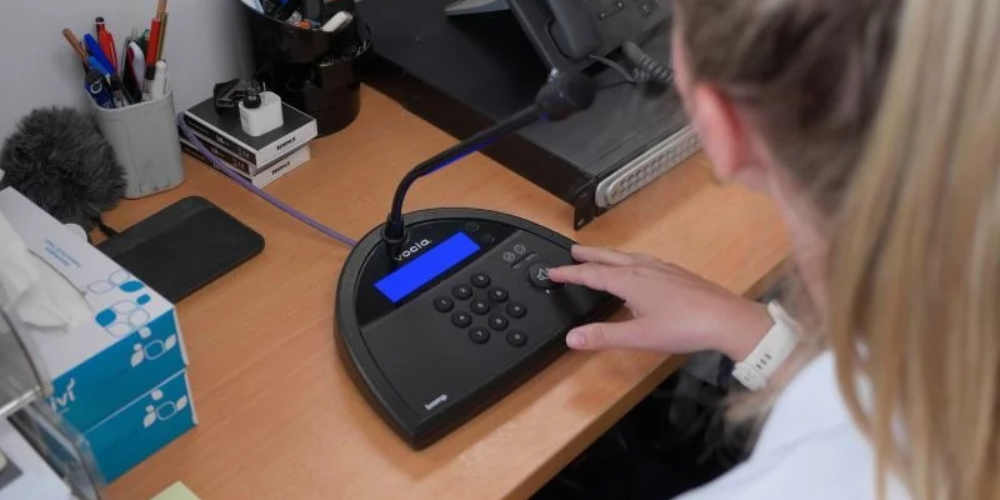
The college uses live announcements because students respond more reliably to familiar voices, particularly during emergency drills. Staff deliver those announcements through Biamp DS-10 paging stations installed in administration areas.
It’s an operational choice, not a technical limitation. The college found that a recognized voice gets a faster response than a recording when it counts.
What Should IT Leaders Consider for Life-Safety Messaging?
IT leaders should treat voice evacuation as critical infrastructure, judged by how it behaves when the network or power fails. Cardijn College’s deployment answers that test with per-site cores and unattended recovery.
You should also confirm how any platform you evaluate meets your local life-safety requirements. The architecture choices, from campus-level independence to automatic restart, are what keep emergency paging available during the events that trigger it.
How Will the College Scale the System to New Campuses?
Cardijn College plans to replicate its existing Vocia configuration at future campus expansions at the Larkin and Aldinga sites, including the fourth campus now in development. Reusing a known design shortens planning and reduces risk at each new site.
Sayce credits the platform’s straightforward expansion as a key reason to stay with it.
“It’s very easy to expand. Once you get your head around how it works, it’s a very straightforward product,” Sayce says.
What Can IT Decision-Makers Take From the Cardijn College Deployment?
The main lesson is that independent site cores, automatic recovery and a repeatable configuration keep a multi-campus paging system dependable for years with minimal IT effort. Each campus stays protected from failures elsewhere, and new sites follow a proven template.
Cardijn College’s ICT director doesn’t measure success by features. He measures it by how rarely he has to think about the system, and that’s the standard you should hold any life-safety platform to.
If you enjoyed this article and want to receive more valuable industry content like this, click here to sign up for our digital newsletters!








Leave a Reply